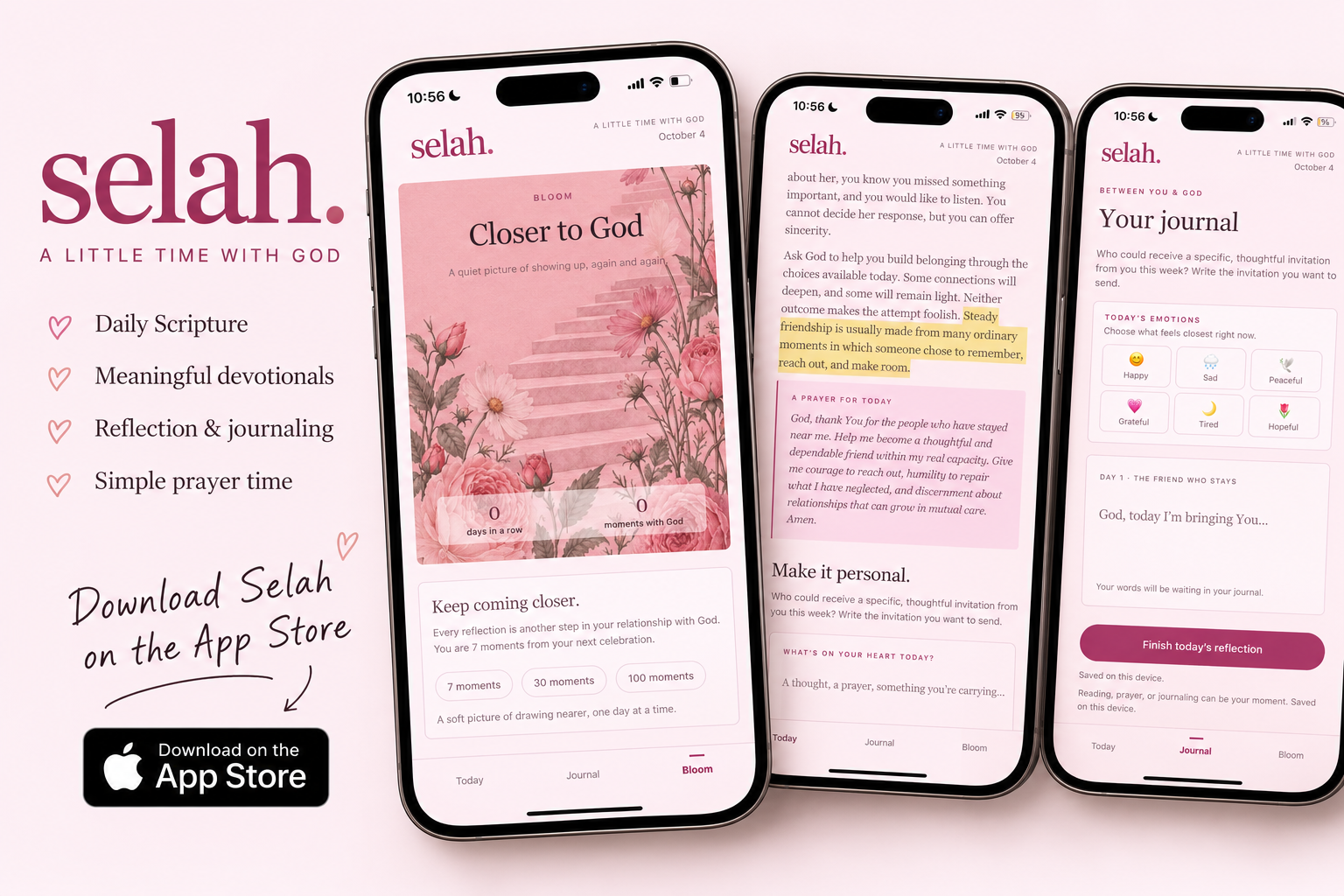
Selah started because I wanted to spend more intentional time with God.
That sounds simple, but in real life it wasn’t.
There is always something competing for my attention. Work. Notifications. Messages. Another thing I need to do. Another tab open somewhere. Even when I intentionally set aside time for God, I found myself wanting something that would help me slow down, focus, and actually reflect instead of just reading something quickly and moving on.
I tried looking for a devotional app that felt right for me, but I couldn’t quite find one.
So eventually I had the thought that tends to get me into trouble:
What if I just made it?
At the same time, I had another reason to build something.
At work, I lead a technical team, and two of the engineers I work closely with, Shiv and Annes, are really good at React. I can bring them a problem and they seem to immediately understand where to go, what to change, and how to make it work.
I realized I didn’t want to only be the person asking the questions.
I wanted to understand more of what was happening underneath.
Two reasons to build one thing.
So Selah became two things at once.
It was a problem I genuinely wanted to solve for myself, and it was a reason to get my hands dirty with React and actually learn by building something real.
I could have watched tutorials. I could have followed another “build a to-do app in React” course.
But I know myself well enough to know that I learn better when I care about what I’m making.
With Selah, every problem had a purpose. I wasn’t learning React just to learn React. I was figuring out how to create an experience I actually wanted to use.
And somewhere along the way, it became more than practice.
It became my first real app.
There are still things I want to improve, and there are probably a hundred decisions I would make differently if I started again today. But that is also part of why I’m proud of it.
Selah exists because I wanted more intentional time with God, because I was curious enough to try building the thing I couldn’t find, and because I wanted to push myself beyond simply understanding technology from a distance.
Turns out the best way for me to learn how something works is still the same way it has always been:
Make something I actually care about.